There are things AI influencer agencies won't tell you up front, but we'll tell you because it's the right thing to do. We've got lots of experience with AI, and we want to help you understand this new marketing space. To work alongside you as our clients, we need to bring you up to speed.
The first thing: when we're trying to recreate a location, like a shop interior or a kitchen, the final images are never a forensic copy of the real place, even if you give it photographs to work from.
Secondly, your approved script can still come out of the model's mouth wrong. Unpredictably, some of the simplest words are wrong from attempt to attempt.
Neither are flaws we're hiding. You need to understand that both are the nature of the generative tool, and neither issue is where this tool delivers real value.
We built a location using a client's own reference photos, and while it has the room's feel, it's not a photographic copy.
This is their own kitchen, photographed, described in a prompt, reimagined by the AI tool, and presented as a brand new image.
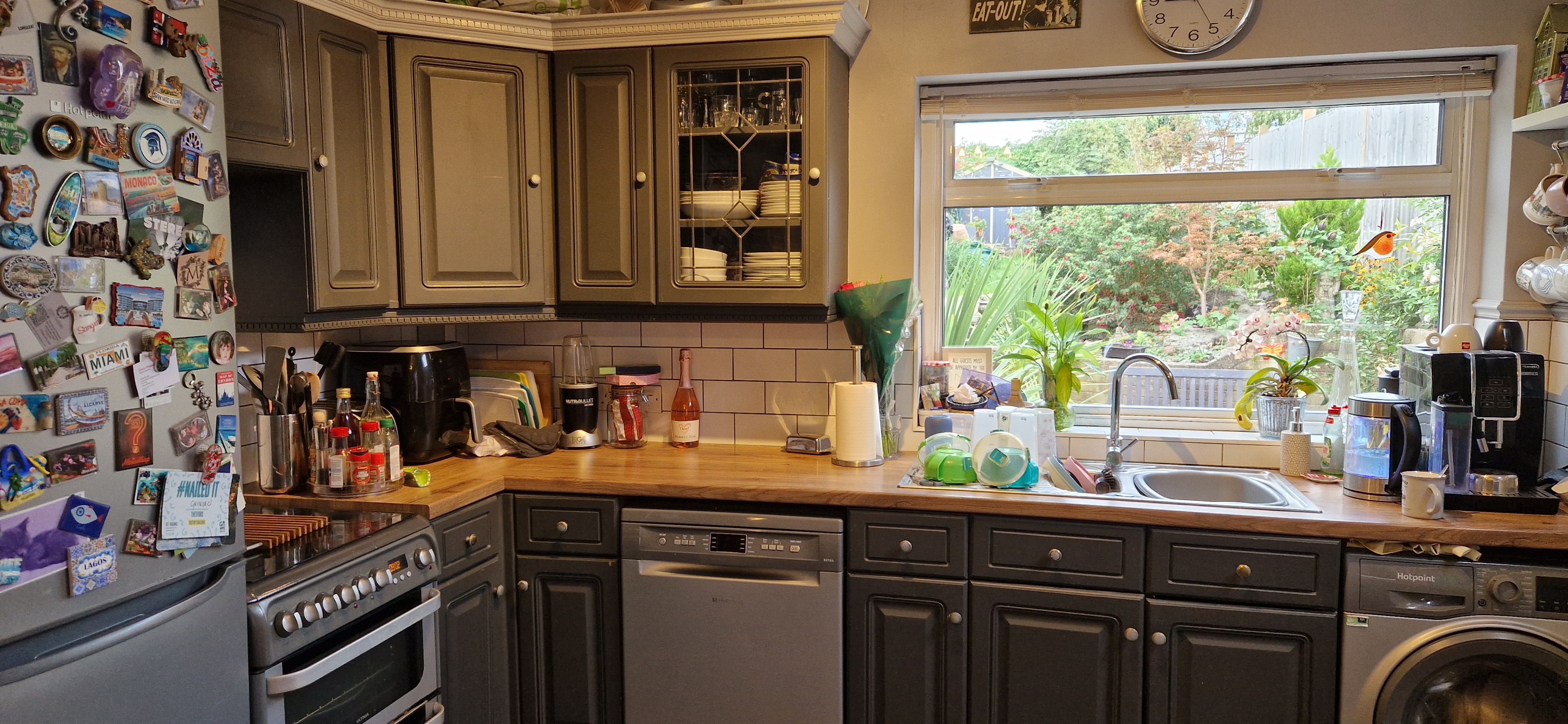
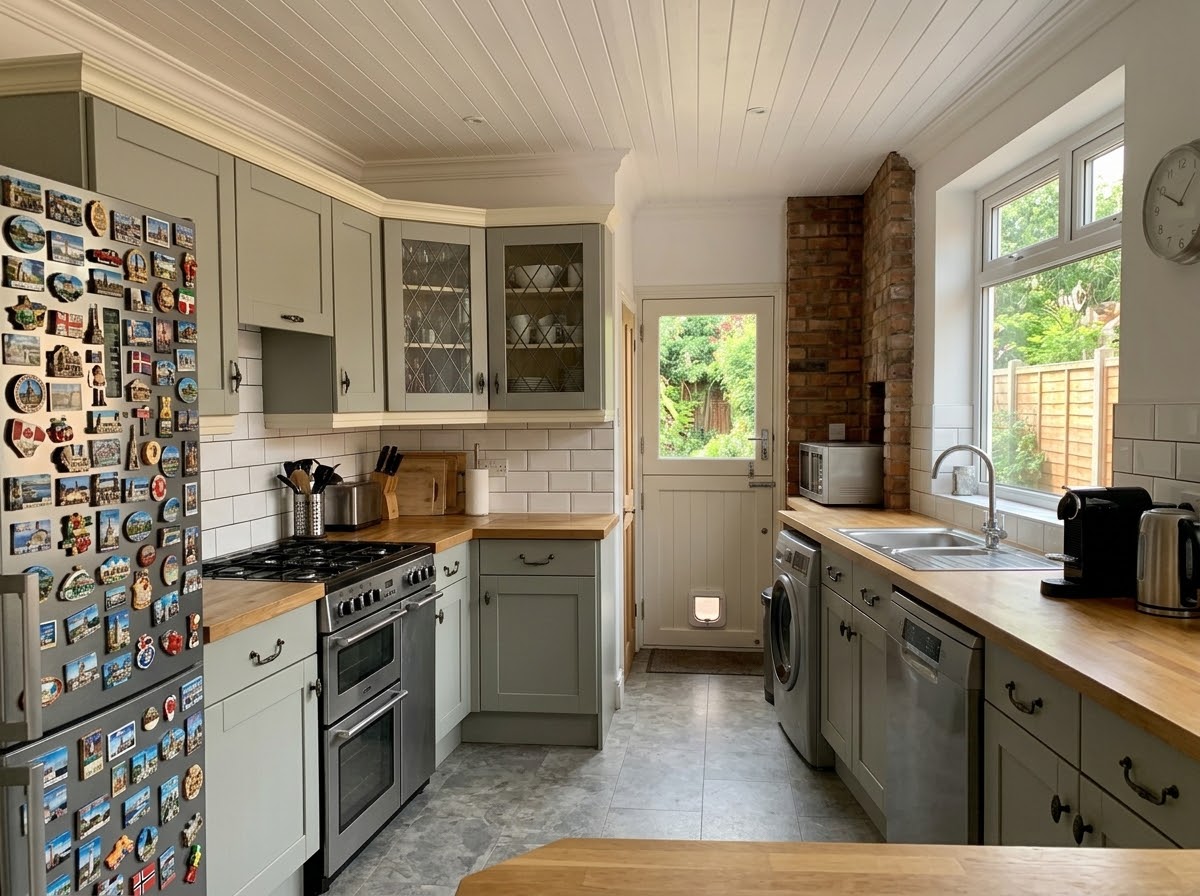
Side by side, you can see both the similarities and differences: the cabinet colour, worktop, tiling and layout are all there, but it isn't a pixel-for-pixel copy of the room.
A reimagining is the best description of what this kind of set-building can do, and it's what we tell a client before we build theirs, to set their expectations up front and so we never have to apologise afterwards.
The same underlying unpredictability shows up in how a script actually gets spoken aloud.
We think it's honest to tell you that Marcus Reid AI’s own promo-video production, one of the personas built by the same production project, ran into a few problems.
One product name (Payhip) was never spoken correctly across three separate takes of the same script: “paytad”, then “Paystun”, then “Pay hit”.
The word “workbook” fared no better, pronounced as “workbok”, like springbok, in two takes. It was delivered correctly once a hyphenated respelling was tried, then failed the same way again in the very next full take.
These were the same words, read by the same engine, giving a different wrong answer each time.
Each take burns credits, and it costs real money to buy more.
So both words were simply removed from the script: the product name became “link in the description”, “workbook” became “PDF”. This was much more efficient.
But the very next take broke two brand-new words nobody had seen fail before, with a third word, already fixed twice, wrong again for a third time.
That's genuinely stochastic behaviour.
This is a term you'll hear in AI generation, and it simply means a random output even when the process is known.
This is another term you'll hear in AI generation: the opposite of stochastic is deterministic behaviour, like a photocopier copying a sheet of paper. The output is exactly as expected.
If AI was like a photocopier, it might only copy different parts of a single page every time you tried.
This was an expensive few rounds, which cost close to a third of a month's entire generation budget, before we came up with a solution.
What fixed it was a clever person in our team switching the whole delivery to a different generation engine for one clean, full-script pass.
Longer term, we accepted that some words simply won't be trusted to this generation step at all.
[We don't think that AI will be taking our jobs anytime soon.]
What overcomes it, every time, is one of our human team, rewriting around any issue before a client ever sees the take.
It's not, as many people think, us just hammering away using ever more expensive models, burning through generation budgets.
Barry Scott sold Cillit Bang for years shouting "Bang, and the dirt is gone" at a camera, played by an actor called Neil Burgess. Nobody thought Barry was a real cleaning obsessive giving an independent opinion, and nobody minded, because the performance was obviously a performance.
We've spent years enjoying the made-up world of TV marketing, and that's what let people enjoy it rather than feel misled by it.
A Cast of One AI presenter works the same way. Everyone knows about AI, and if they are watching one of our influencers we always tell them that they're watching a "real" AI character.
As a client of ours, seeing an AI-generated setting that's an impression of a real kitchen rather than a photograph of it doesn't undermine your customers' trust. It reinforces it.
We have had three years of hands-on generative AI experience: text, images, coding and now video generation.
We waited to launch this service until the generation costs got much cheaper and the video and speech models got much better.
Better, but by no means perfect.
We've been using generative AI since ChatGPT and Claude first launched, long enough to know the ragged edge by feel before we ever had a name for it.
The "ragged edge" is how AI experts describe the seesaw feeling between the moment when the model is a genius, matching or beating what a skilled person would produce, and minutes later, on the exact same kind of task, it's so inconsistent you want to pull your hair out.
Even when we started out, our instinct was to blame the prompt. Everyone thinks they are the problem: write it more carefully, add more detail, be more precise, and surely it will behave.
After three years of working with it, the truth is the inconsistency is the tool, not you. No amount of prompt-perfecting removes it, because the problem is not the wording. It's an essential property of how these models generate anything at all.
That's the process behind Cast of One AI. It's the film industry's own model, adapted: script, scene and direction settled first, all the cheap steps, well before a single frame of expensive footage gets shot or generated in the AI world.
We've modified it for what we do, with an AI agent doing the work of each key crew role, researcher, scriptwriter, location and design, rather than a human department for each. That's what makes running the discovery stage properly, rather than skipping it under time pressure, faster and cheaper than the traditional version of this same process, not a shortcut.
AI does this process stuff really well.
Surface drift, by which we mean, for example, a slight difference in the position of a window in a rendered set, is a property of the tools.
We can accept it, and honestly disclosing it to clients costs us nothing, because no client is paying us for pixel-perfect reproduction of a room. We don't do that type of work.
What happened with the promo video's problem words is completely different.
We hit the limit of what a generation step can be trusted to say, and so we resolved it in a simple, human way, before a client ever saw a take.
Our promises are built into the process: the client writes or approves every claim at the script stage, and the words are locked before generation starts.
Then, importantly, a person checks the finished take against the brief by ear, every time, listening for any potential issue and providing a solution.
When a client sees their own kitchen come back slightly different from what they pictured, the instinct is to wonder if they described it badly. They didn't. The brief did its job; the model interpreted it rather than copied it, because that's what a generative model does with any description, however precise.
Worrying over a worktop is worrying over the wrong thing.
We've shown you behind the curtain. That's the first step to an honest relationship, not a sales pitch.
So, after reading all this, if you still want to go ahead, then you're the type of enlightened client we love to work with.
Send us an email at hello@castofoneai.co.uk.